


What Are Medication Errors in Care Homes?
'Medication errors' typically refer to inappropriate medications. But missed medication is not alone responsible for this issue.
The area of medication errors is quite extensive.
Errors may happen due to wrong prescribing, incorrect diagnosis, dose miscalculations, poor drug distribution practices, and drug- and drug-device-related problems.
Incorrect drug administration, failed communication, and lack of care staff training also maximise error rates.
Why Do Medication Errors Matter in Care Homes?
Research shows 270 million medication occurrences in the United Kingdom. Among this number, 90% happen in care homes.
This severe mistake does not just harm the residents’ health – it affects their wellbeing and confidence.
Some residents are more vulnerable due to their age and frailty. They may face more difficulties due to medication errors. Especially, it could be more horrific for the residents with dementia.
Medication errors also reduce the trust and reputation of a care home.
The Most Common Types of Medication Errors in Care Homes
Here is a detailed breakdown of the most common types of mediation errors in care homes and their key reasons.
Wrong dose
One of the most common and frequent errors in medication involves the wrong dose. This wrong dose typically refers to using the incorrect amount of medication.
This major mistake could lead to severe harm to the residents living in the care home.
Let’s give a real-life example –
Imagine a patient was prescribed 5 mg of a drug, but mistakenly he got more or less than that from the prescription.
In both cases (over- or under-amount), cause severe health issues.
Miscalculation of decimal points and misinterpretation of units, such as confusing millilitres, are also common causes of wrong doses.
One of the key reasons for this issue is carelessness from care staff. It might happen due to their fatigue, overwork, or lack of training.
On the other hand, unclear prescriptions are another major reason for this issue.
However, whatever the reason, it must be resolved with proper training and awareness among the individuals involved in medication administration in social care.
Missed dose
A missed dose can significantly reduce a medicine’s therapeutic effect and increase hospitalisation.
For some specific medications, e.g., warfarin, a few missed doses increase uneasiness and cases of adverse effects.
The key reason for a missed dose in a care setting is a lack of documentation and the practice of tracking medication for each patient.
In some cases, unclear shift handover also causes this problem.
Wrong time
According to the pharmacists' perspective, giving medicine 60 mins early or late is usually defined as the wrong time in medication administration.
It not only reduces the effectiveness of a drug, but it can even cause adverse health issues for the patients.
In a social care setting, the key reasons for wrong timing are staff shortage, workload pressure, and, of course, lack of training for care staff.
Remember, timing is critical for many medications, particularly those for pain management, diabetes, or Parkinson’s disease.
Wrong resident
In some cases, confusion might happen between residents with similar names and a high chance of giving medication to the wrong person.
Incorrect or incomplete MAR entry
Healthcare professionals must maintain the MAR (medication administration record) for a patient in real time. It involves tracking doses, error prevention and ensuring constant care and keeping patients' details such as their name, dosage, drug name, time and route.
Poor handling of PRN or time-sensitive medicines
PRN, or time-sensitive medicines, stand for 'pro re nata' – this type of medication has no particular scheduling, but it may be given to a patient if the symptoms arise.
Antipsychotics, anxiolytics, sedatives and hypnotics; painkillers; gastrointestinal medications, etc. are the most common types of PRN. For example, a patient suddenly faces pain from his particular disease and has a prescription for a painkiller if it happens.
But care staff may not be trained enough to make sure the patient really needs the time-sensitive medicines at that moment.
After reviewing these mentioned medication errors, one thing is common – the key reason for medication errors is poor medication training for care staff and a lack of awareness.
In the upcoming sections, you will get a detailed idea of how proper medication management could reduce these erosions.
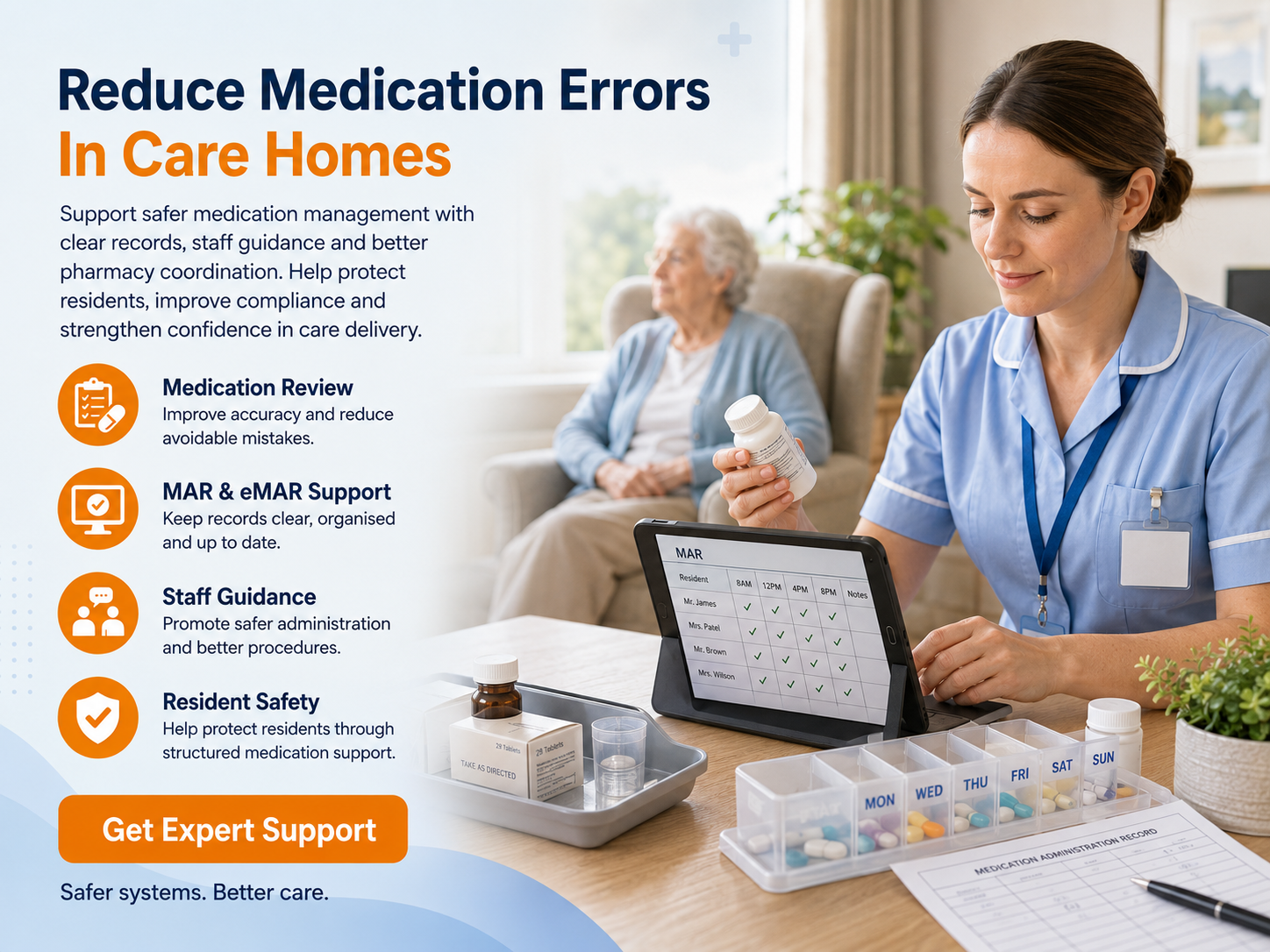
Need Help Reducing Medication Errors in Your Care Home?
Contact Medicina Pharmacy to arrange support for safe medication management, staff training, and care home medicine processes.
Call: 01604345869At What Stage Do Medication Errors Usually Happen?
The main stages where medication errors in care homes commonly happen include:
1. Prescribing:
Errors may start when a medicine is first prescribed. This involves incorrect dosages, unclear instructions, or missed considerations such as allergies or drug interactions.
2. Transcribing or recording transfer:
When prescription information is manually copied into care home systems or MAR charts, mistakes can occur. This stage is vulnerable in systems that are not fully digital. Its accuracy depends on manual input and communication between healthcare professionals.
3. Dispensing:
Pharmacies play a critical role here, but dispensing errors can still happen, such as selecting the wrong strength or quantity of a medicine before it reaches the care home.
4. Delivery, storage and preparation:
Medicines may be mislabelled, stored incorrectly, or delayed. It can affect availability and lead to missed or late doses.
5. Administration:
Mistakes may include giving the wrong dose, missing a dose, or administering medicine to the wrong resident.
6. Monitoring and review:
If changes to medication are not reviewed regularly, increasing risk over time.
Most medication errors in the elderly are system-related rather than isolated incidents.
What Should Happen When a Medication Error Occurs?
In case any medication error happens, the priority must be the resident’s safety. Care staff should check if there is any possibility of adverse effects.
If yes, seek immediate medical attention, contact the GP or be hospitalised if needed.
The next important job is accurate documentation. Either an error or a suspected error, the care authority should record it clearly.
Managers should be informed promptly. Moreover, they should inform the resident’s family member about the incident.
Every medication error should lead to learning. Make a structured review to identify why that incident happened – were there unclear instructions, communication breakdowns, or workload pressures?
How to Prevent Medication Errors in Care Homes
A care home can significantly reduce medication errors by providing proper training to its care staff.
It mainly includes structured medication management and compliance guidance.
Besides this, proper documentation is essential to reduce the mediation errors. Using paper and electronic MAR systems will help to record and track data that helps to reduce possible mistakes.
Moreover, the care authority must maintain clear communication among pharmacies, GP practitioners, and the residents.
It helps to maintain clear prescribing, accurate dispensing, and organised medication management.
How Better Pharmacy Support Helps Reduce Medication Errors
Pharmacy support is a key part of reducing medication errors in care homes. When medicines are clearly labelled and aligned with current prescriptions, the risk of confusion during administration is significantly reduced.
Pharmacies also support care homes with medication records, including MAR or eMAR systems, which help reduce transcription errors and discrepancies.
Pharmacies often act as a central point of communication, helping to ensure that updates are shared quickly and accurately. This reduces delays and supports continuity of care.
Pharmacist-led medication reviews can identify unnecessary medicines, duplications, and potential drug interactions. In many cases, this leads to a safer and more manageable medication regimen.
Moreover, pharmacies can support audit and compliance processes. A strong pharmacy partnership plays a vital role in improving safety, consistency, and efficiency in medicines in care homes.
Medication Errors in Care Homes UK: Statistics and Context
A UK study in care homes found that 69.5% of residents experienced at least one medication error. This included errors across prescribing, dispensing, administration, and monitoring stages.
However, not all medication errors result in harm. Some are classified as low-risk, but they still indicate weaknesses in systems and processes.
FAQs
Here are the answers to the most common queries related to medication errors in care homes.
What are the most common medication errors in nursing homes?
The most common medication errors include missed doses, incorrect doses, administering medication at the wrong time, giving medication to the wrong resident, and errors in record-keeping. These issues are often linked to communication gaps or outdated records rather than isolated mistakes.
What are the 5 medication errors?
In care settings, the five commonly recognised errors relate to the “five rights” of medication administration: wrong resident, wrong medication, wrong dose, wrong time, and wrong documentation. These form the foundation of safe practice.
What are 6 medication errors?
A broader list may include missed doses, duplicate doses, incorrect medication, wrong timing, incorrect resident, and incomplete or inaccurate MAR entries. Each reflects a different stage where systems can fail.
What are the 4 P's nurses should stay away from?
This is not a formal or widely recognised framework in UK care guidance. Instead, best practice focuses on following structured medication procedures, maintaining accurate records, and escalating concerns appropriately.
What are the top 5 medical errors?
Across care settings, common errors include medication mistakes, communication failures, documentation errors, delays in treatment, and coordination issues between providers.
What is the most common error in patient care?
Medication administration errors are among the most common, particularly in environments where residents have multiple prescriptions and care is delivered across shifts.
During which stage of patient care are medication errors most common?
Errors can occur at any stage, including prescribing, dispensing, recording, and administration. However, administration and record transfer stages are particularly vulnerable due to reliance on accurate, up-to-date information.
What three steps must be taken when a medication error occurs?
The key steps are to ensure the resident is safe, seek appropriate clinical advice, and record and report the incident according to policy.
What time do most medication errors occur?
There is no single consistent time, but errors are more likely during busy periods such as medication rounds or shift handovers.
What are the three ways of reducing errors?
Errors can be reduced through strong systems, effective staff training, and clear communication between all parties involved in medication management.
What are the five steps to reduce medication errors?
A practical approach includes standardising procedures, maintaining accurate records, ensuring staff competency, improving communication, and learning from incidents.
What are the three main errors?
The three main categories are prescribing errors, administration errors, and documentation errors.
What are the 8 ways to force an error?
The common 8 ways to force an error include poor communication, manual processes, incomplete records, interruptions, delayed updates, lack of training, absence of real-time systems, and inconsistent procedures.
Improve Medication Safety with Medicina Pharmacy
Speak with Medicina Pharmacy about support for medication systems, staff confidence, and safer care home medicine management.
Call: 01604345869Final Thoughts: Reducing Medication Errors in Care Homes
Medication errors in care homes are preventable through well-structured medication management.
Care homes should focus on real-time visibility, consistent processes, and strong pharmacy partnerships to manage medicines safely.
This practice will improve the well-being of home residents and strengthen compliance, inspection readiness, and trust with families.