
Introduction
Managing medicines in care homes safely requires more than a medicine round and a completed MAR chart. NICE guideline SC1 sets out a whole-system approach covering medicines policies, communication, reconciliation, prescribing, ordering, storage, administration, review, self-administration, covert administration, staff competence and learning from incidents.
The guidance applies to adults, children and young people living in care homes, including homes with nursing. It is good-practice guidance rather than a substitute for legislation, regulatory requirements, local procedures or resident-specific clinical instructions. Care providers must interpret it alongside current CQC expectations, professional standards and their own lawful governance arrangements.
This article explains the practical meaning of managing medicines in care homes under NICE SC1 and the related NICE quality standard QS85. It keeps the broad commercial role with Medicina Pharmacy’s care home medication management service, while giving managers and medicines leads a focused implementation guide.
What does NICE guidance on managing medicines in care homes cover?
NICE SC1 follows the medicines pathway from the point information is received or a medicine is prescribed through to ordering, supply, administration, monitoring, review and disposal. The central principle is that systems should be person-centred, accurate, auditable and clear about who is responsible for each action.
For managers, managing medicines in care homes therefore means connecting policy, staff competence, resident choice, pharmacy and GP communication, records, stock, storage, incident learning and clinical review. A strong result in one area cannot compensate for a weak handover, an unclear prescription or an unrecorded omission elsewhere in the pathway.
NICE QS85 does not replace SC1. It highlights priority areas where services should be able to demonstrate high-quality practice, including accurate medicines information during transfers, support for self-administration, clear instructions for newly prescribed medicines, multidisciplinary medication reviews and a documented process for covert administration.
1. Build and regularly review a care home medicines policy
For managing medicines in care homes, every provider should have a written medicines policy that reflects current legislation, best available evidence and the way the home actually operates. The policy should identify responsible roles, escalation routes and the records needed to show that the process was followed.
The policy should cover information sharing, accurate records, medicines-related problems and safeguarding concerns, medicines reconciliation, reviews, prescribing and monitoring, ordering and supply, receipt, storage, disposal, self-administration, administration, covert administration and staff training and competence. It should also explain how the home works with prescribers, pharmacies and other health and social care professionals.
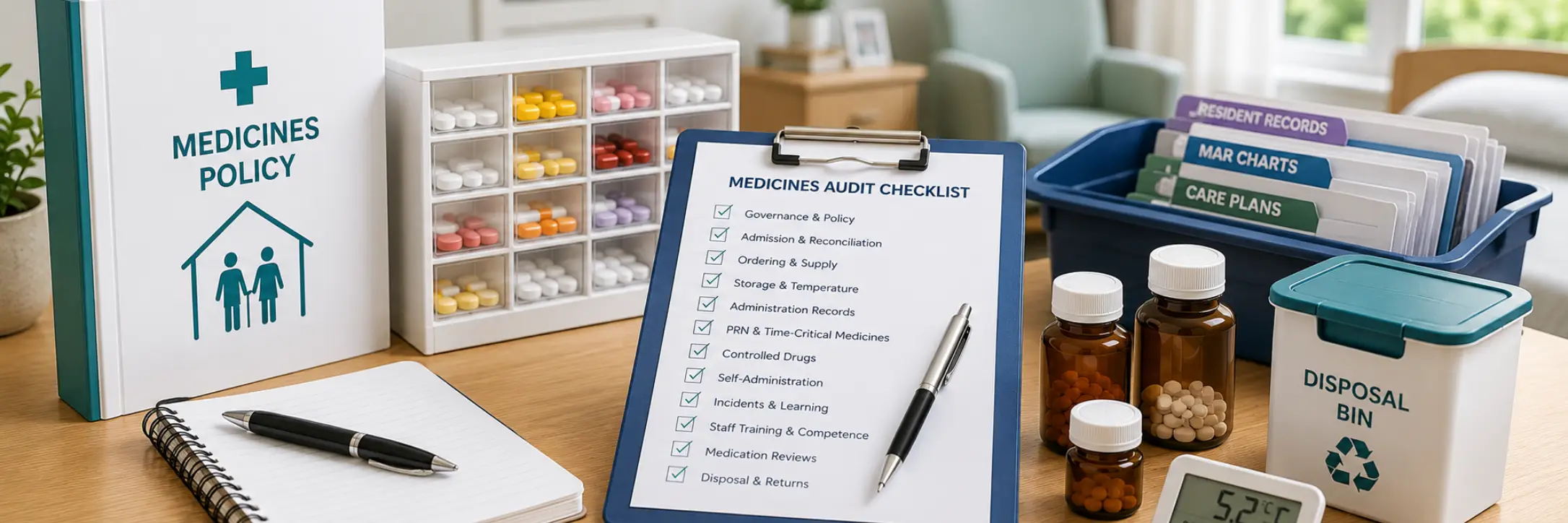
A policy is only useful when staff can apply it. Review it whenever guidance, legislation, systems, pharmacy arrangements or local practice change, and after serious incidents or repeated near misses. A planned care home medicines policy checklist can help managers test whether each required process has a named owner, evidence source and review date.
2. Put residents, consent and independence first
NICE expects managing medicines in care homes to begin with the resident rather than the packaging system. Residents should receive understandable information about their medicines and be involved in decisions, with family members or carers involved when the resident agrees or when lawful decision-making arrangements require it.
Care staff should not assume that moving into a care home removes a person’s ability to manage medicines. Residents should be presumed able to self-administer unless an individual risk assessment indicates otherwise. The assessment should consider capacity, dexterity, risk to the resident or others, storage and the level of support required.
The outcome belongs in the care plan and should be reviewed when health, cognition, medicines or circumstances change. Some residents may manage certain medicines independently while needing help with others. Support should be proportionate, recorded and designed to preserve independence wherever it is safe to do so.
3. Keep medicines information accurate during transfers
In managing medicines in care homes, transfers into a care home, returns from hospital and moves between services are high-risk points. NICE quality standards emphasise that an accurate list of a person’s medicines should be produced and recorded on the day of transfer so treatment can continue safely.
Medicines reconciliation should confirm the medicine name, strength, formulation, dose, route and timing, as well as allergies, recent changes, short courses, intended stop dates and monitoring requirements. Staff should compare available sources rather than rely on one document when information conflicts or appears incomplete.
Unresolved discrepancies should be escalated promptly to the relevant prescriber, pharmacy or transferring service. The care home should record who checked the information, which sources were used, what was clarified and how the final instructions were communicated to the staff responsible for administration.
4. Arrange regular, person-centred medication reviews
A core part of managing medicines in care homes is making sure residents have their medicines reviewed according to clinical need and at least once a year. More frequent review may be needed after significant health changes, hospital discharge, falls, adverse effects, repeated refusals, swallowing difficulties or concerns about whether treatment remains beneficial.
A named health professional should take responsibility for coordinating the review. NICE describes a multidisciplinary approach that can involve the resident, family or carers where appropriate, the GP, pharmacist, nurse, care-home staff and other relevant practitioners.
A review should consider whether each medicine is still needed, whether the dose or formulation remains suitable, whether monitoring is complete, whether adverse effects or interactions are present and what matters to the resident. Decisions, responsibilities and follow-up actions should be documented and shared with everyone who needs them.
5. Make prescribing and monitoring instructions unambiguous
Safe managing medicines in care homes depends on prescriptions and administration instructions that staff can interpret consistently. Newly prescribed medicines should arrive with enough information about how and when to use them, what benefit is expected, what should be monitored and when the plan should be reviewed.
For “when required” or variable-dose medicines, instructions should state the indication, dose range, minimum interval where relevant, maximum amount in 24 hours and the circumstances for seeking clinical advice. Vague directions such as “take as directed” are not enough for a care team that must make and record a defensible administration decision.
The same principle applies to medicines with special timing, monitoring or administration requirements. Care-home staff should not rewrite or interpret unclear instructions independently. They should obtain clarification from an authorised prescriber or supplying pharmacy and update the resident's records before administration.
6. Order, receive and store medicines through controlled processes
For managing medicines in care homes, NICE recommends that at least two staff members have the training and skills needed to order medicines, so the system does not depend on one person. The ordering process should compare current prescriptions, MAR or eMAR records, recent changes and existing stock before a request is submitted.
The detailed monthly workflow belongs with the specialist guide to ordering medication in care homes. Within the wider NICE framework, managers should also ensure that outstanding prescriptions are tracked, deliveries are reconciled against the order and prescription, discrepancies are escalated and discontinued stock is separated from medicines in active use.
Storage arrangements should protect residents, preserve medicine quality and restrict access to authorised people. The policy should address room-temperature and refrigerated medicines, controlled drugs, medicines for self-administration, keys or access controls, temperature monitoring, stock rotation and secure storage before disposal.
7. Administer medicines safely and maintain reliable MAR or eMAR records
Only trained and assessed staff should administer medicines. They should check the correct resident, medicine, strength, dose, route and time against the current authorised record and follow any medicine-specific instructions. Interruptions, rushed handovers and unclear responsibilities should be treated as system risks, not normal features of the round.
The administration record should be completed at the time of the event. Staff should use the agreed code and narrative for refusals, omissions, medicines not available, PRN doses, self-administration or other exceptions, then follow the home’s escalation process where a missed or delayed dose may create clinical risk.
Paper MAR and eMAR systems can both support managing medicines in care homes when the underlying information is accurate and staff use the system correctly. Medicina’s guide to medication systems for care homes explains how dispensing, records, delivery and communication can be connected without treating technology as a substitute for governance.
8. Respond to errors, near misses and safeguarding concerns
A safe approach to managing medicines in care homes requires the resident’s immediate safety to be the first priority when an error or suspected error occurs. Staff should obtain clinical advice where needed, monitor the resident, preserve relevant information and follow local escalation, safeguarding, notification and duty-of-candour processes where they apply.
The record should describe what happened, when it was identified, what medicine and resident were involved, the advice obtained, actions taken and who was informed. Near misses also matter because they reveal weaknesses before harm occurs.
The purpose of review is learning, not simply identifying the person closest to the incident. Managers should look for contributing factors such as unclear prescribing, transcription, supply delays, staffing, interruptions, training gaps or poor handovers. The specialist article on medication errors in care homes provides a deeper prevention and incident-learning framework.
9. Use covert administration only through a lawful, medicine-specific process
Within managing medicines in care homes, covert administration means giving a medicine in a disguised form without the person knowing. It must never be used for convenience, because a resident refuses, or because staff believe treatment is generally beneficial.
The process requires a decision that the person lacks capacity for the specific medicines decision, followed by a best-interests decision involving the appropriate people. A prescriber should confirm that treatment remains necessary, and a pharmacist should advise whether the particular medicine can be altered or mixed with food or drink without affecting safety or effectiveness.
The care plan should identify each medicine covered, the agreed method, who was involved, how administration will be recorded and when the decision will be reviewed. Capacity and best interests are decision-specific and may change, so the arrangement must not continue automatically.
10. Train staff and review competence
For managing medicines in care homes, training alone does not demonstrate competence. Before a staff member manages or administers medicines, the provider should assess whether they can apply the home’s policy, use the MAR or eMAR system, recognise problems, communicate concerns and respond safely to exceptions.
NICE and current CQC guidance support an annual review of the knowledge, skills and competence of staff who provide medicines support, with additional assessment after changes in role, systems or practice concerns. Supervision, observed practice, reflective learning and targeted retraining can all contribute to the evidence.
Records should show the learning completed, the competence assessed, the assessor, the outcome, any restrictions and the next review. Care homes reviewing their workforce arrangements can also use Medicina Pharmacy’s medication training for care homes page as a service-specific next step, subject to current eligibility and delivery terms.
How NICE SC1 and QS85 work together
SC1 provides the broad good-practice recommendations for the complete medicines pathway. QS85 selects priority areas that can be translated into measurable local evidence. Used together, they help a provider move from a policy statement to questions such as: Is transfer information complete? Are residents supported to self-administer? Are new prescriptions clear? Are reviews multidisciplinary? Is covert administration governed and reviewed?
Neither document should be treated as a one-off inspection checklist. Managing medicines in care homes is a continuing governance process. The evidence should show not only that procedures exist, but that staff follow them, exceptions are escalated, residents are involved and improvements are checked after action is taken.
How to turn NICE guidance into a practical care-home system
Managers can make managing medicines in care homes operational by translating NICE guidance into a simple improvement cycle:
1. Map each SC1 topic to the home’s medicines policy, named owner and evidence
source.
2. Check that resident-level care plans, risk assessments and administration
instructions match current practice.
3. Sample recent transfers, medication reviews, orders, deliveries, MAR or eMAR
entries, incidents and covert-administration plans.
4. Record gaps as specific actions with an owner, deadline and evidence of
completion.
5. Share lessons with staff, the supplying pharmacy, GP practice and other partners
where the issue crosses organisational boundaries.
6. Reassess staff competence when findings show a practice or knowledge gap.
7. Re-audit the affected process to confirm that the change is working in
practice.
This approach keeps managing medicines in care homes focused on resident outcomes
and auditable improvement rather than document completion alone.
Care Home Medication Management Support
Medicina Pharmacy’s care-home service page describes support across the medicines pathway, including prescribing, ordering, transport, storage, administration, monitoring and review.
Support should be agreed around the care home’s actual processes, residents and local GP and pharmacy arrangements. It does not guarantee compliance or replace the provider’s medicines policy, governance, staff competence or clinical responsibilities.
Conclusion
Managing medicines in care homes under NICE guidance means building a connected, person-centred system from policy and information sharing through prescribing, ordering, storage, administration, review and learning. SC1 provides the broad process, while QS85 highlights priority areas where services should be able to demonstrate reliable practice.
Care-home managers should use the guidance alongside current law, CQC requirements, local procedures and individual clinical instructions. Clear responsibilities, accurate records, resident involvement, competent staff and effective communication with prescribers and pharmacies are the foundations of safer medicines support.
Care homes that need pharmacy input can review Medicina Pharmacy’s care home medication management support and discuss how current processes, dispensing arrangements, records and communication could be strengthened. Any support should be agreed for the home’s actual needs and does not transfer the provider’s governance responsibilities.
Written by Saleh Ahmed (Independent Prescriber & Advanced Practitioner, GPhC 2065382). Medically reviewed by Yasmeen Akthar (Superintendent Pharmacist, GPhC 2058731) and Mohammed Shajan Ali (Independent Prescriber, GPhC 2067785). Last reviewed: ADD THE ACTUAL CLINICAL SIGN-OFF DATE BEFORE PUBLICATION.
What is NICE SC1 for care homes?
Is NICE guidance for managing medicines in care homes legally binding?
How often should care-home residents have a medication review?
Should residents be allowed to self-administer medicines?
What medicines records should a care home keep?
How many staff should be able to order medicines?
What is the difference between NICE SC1 and QS85?
Can a pharmacy make a care home compliant with NICE guidance?
Disclaimer
This article provides general guidance for UK care-home services. It does not replace current legislation, regulation, CQC requirements, local policy, professional advice, staff training, contractual arrangements or resident-specific care plans and clinical instructions. NICE guidance should be applied with professional judgement and current local procedures. Service availability and terms may change and should be confirmed directly with Medicina Pharmacy.